
PGT-M and PGT-A can be combined to study both monogenic disorders and aneuploidy starting from a single biopsy.
PGT-M and PGT-A can be combined to study both monogenic disorders and aneuploidy starting from a single biopsy.
Study both monogenic disorders and aneuploidy.
Next-generation sequencing (NGS) is currently the most effective technique available for the study of the genome. It has become an important tool for implementing PGT helped by the study of monogenic disorders and aneuploidy.
Study both monogenic disorders and aneuploidy.


PGT-M
We enable researchers using Illumina technology to test for single-gene mutations in embryos using a single biopsy.
Journey genomics
What it is
PGD-SEQ is a next-generation sequencing (NGS)-based genetic test that enables researchers to conduct preimplantation genetic testing (PGT) in embryos for monogenic disorders (PGT-M).
PGT-M is designed to research monogenic disorders that are caused by variants within a single gene and are inheritable.
Key benefits of the PGD-SEQ kit and software package:

In-house analysis of PGT-M

Obtain results within just 13 hours.

Covering the most common monogenic disorders.

How it works
PGD-SEQ analyzes a 2 Mb region on each side of the target gene, including informative SNPs that enable haplotype construction.
By assessing the zygosity of these informative positions and comparing them with family samples, PGD-SEQ enables researchers to track the inheritance of risk-associated alleles.
Panels are designed using a two-pool format, providing coverage of the gene’s coding regions and supporting direct variant detection alongside linkage analysis.
Workflow for PGT-M by NGS
With PGD-SEQ, family and embryo samples are processed through a targeted NGS workflow to perform linkage analysis and, when possible, direct variant detection. The two-pool design provides broader gene coverage while maintaining a streamlined laboratory workflow.
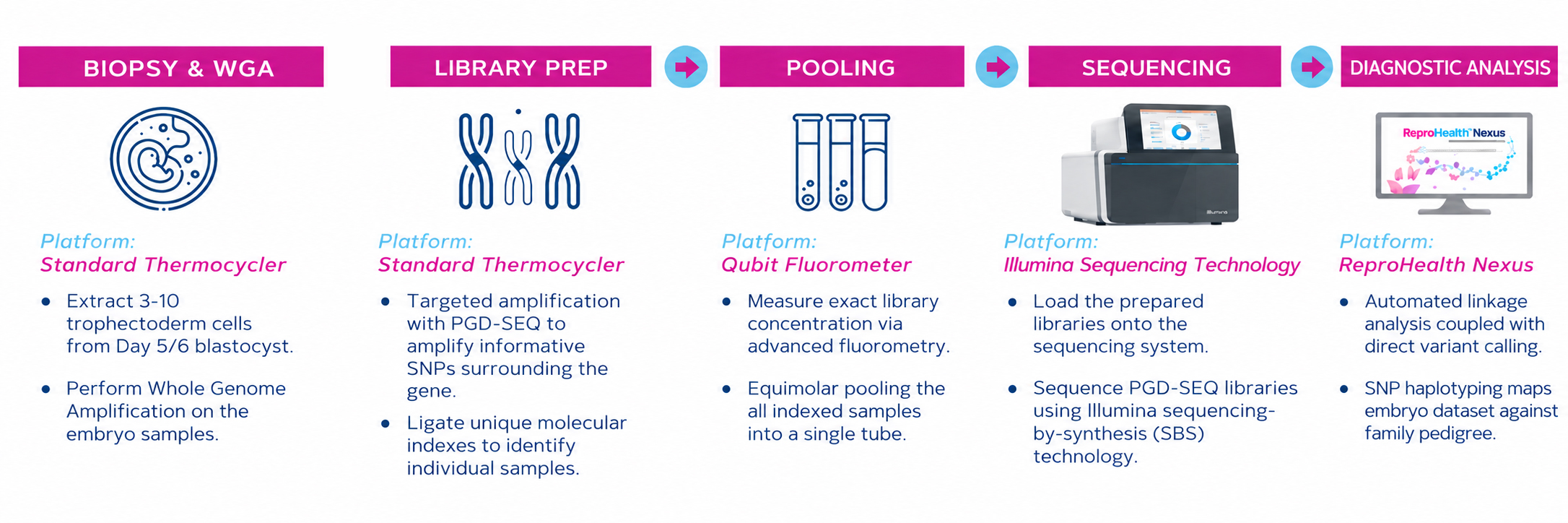
PGT-M analysis can be carried out in as little as 16 hours.
Our PGT-M by NGS panels
To create our sequencing panels, DNA samples from both parents as well as additional family members are requested for testing.
PGT-M allows simultaneous detection of different point mutations and surrounding SNPs, to identify potential allele drop-out phenomenon, accurately calling each research embryo as affected, carrier, or unaffected.

OUR PGT-M TESTS
Panels Available & Customization
Our PGD-SEQ panels use a two-pool design to provide comprehensive coverage of the gene’s coding regions and informative SNPs for PGT-M analysis.
Our team of specialists will evaluate each case and help you identify the most suitable panel according to the gene, familial variant and specific research requirements.
Contact our team to discuss your case and panel availability.
Manual and Protocols

Edificio Quorum III
03202 Elche – Alicante
Spain
Information: info@journeygenomics.com
Support: support@journeygenomics.com